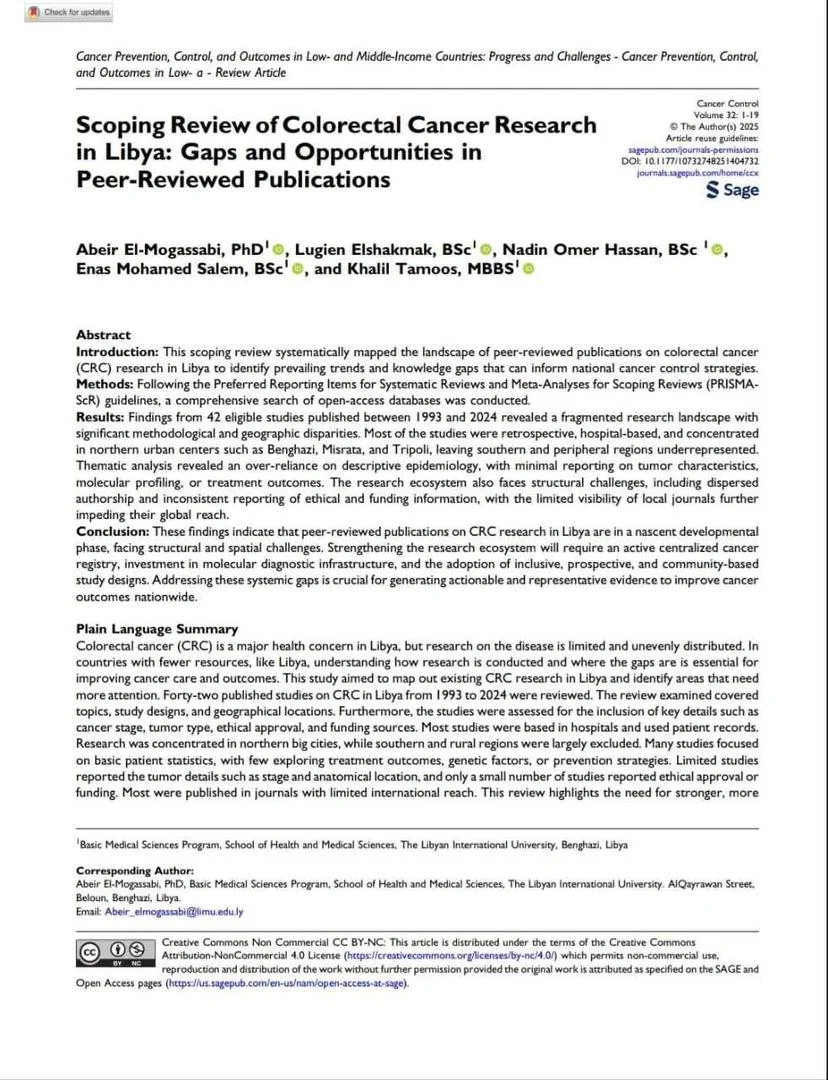
The elite Research and Academic Skills team within the Basic Medical Sciences program-comprising Lujain Al-Shakmak, Nadine Omar Hassan, Enas Mohammed Salem, and Dr. Khalil Tammous, under the leadership of Dr. Abeer Al-Maqsabi at the Libyan International University (LIMU)-
has finalized a scientific study published by the global publisher SAGE titled:
“Scoping Review of Colorectal Cancer Research in Libya: Gaps and Opportunities in Peer-Reviewed Publications”
This work is not merely a medical study; it is a strategic step toward bolstering the global presence of Libyan scientific research.
First, the team expresses sincere gratitude to the editorial staff and anonymous reviewers at Cancer Control. Their professionalism and constructive feedback throughout the submission and peer-review phases were instrumental in refining this work, embodying the rigorous international engagement the study advocates for.
Study Title: “Scoping Review of Colorectal Cancer Research in Libya: Gaps and Opportunities.”
The study, which analyzed 42 scientific papers, accurately mapped the current landscape and identified the following:identified the following:
- Geographical Gap: Research is concentrated in northern regions (Benghazi, Tripoli, Misrata), with a near-total absence of data from southern regions.
- Methodological Shortcomings: Most studies are descriptive and retrospective, relying on hospital-based data, with a severe shortage of research targeting advanced molecular and clinical aspects.
The Methodological Challenge: The “Vicious Cycle” facing Libyan researchers:
The study did not just monitor data; it analyzed structural obstacles preventing Libyan research from reaching global standards, including:
- Limited Resources: Lack of adequate funding and infrastructure forces researchers to rely on available hospital data rather than costly field or molecular research.
- Publication Isolation: Due to high international publication costs and lack of support, most researchers turn to local or unranked journals.
- Absence of Expert Critique: Inability to publish in global journals deprives researchers of rigorous peer review by international experts, hindering the development of methodological skills and affecting research quality.
- Fading Impact: This “invisible” research fails to reach policymakers or attract international grants, returning the researcher to square one.
The study proposes strategic solutions to enhance national scientific output: - Data Centralization: Activating a comprehensive national cancer registry to serve as a unified platform for researchers across Libya.
- Mentorship and Empowerment: Establishing joint supervision programs with global centers (Twinning Programs) to integrate Libyan researchers into international circles.
- Institutional Investment: Providing national grants to cover publication costs in prestigious journals to ensure high-quality scientific review.
- Methodological Development: Shifting toward community-based, prospective, and genetic research that offers tangible solutions for the local health system.
To read the full study, visit the link:
https://journals.sagepub.com/doi/full/10.1177/10732748251404732?mi=ehikzz