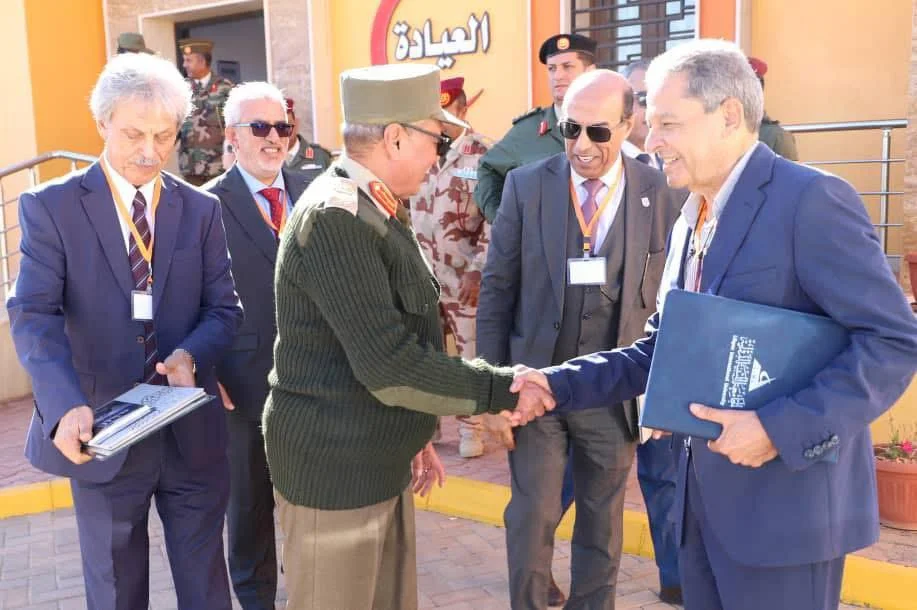
LIMU strengthened its domestic academic partnerships and enhanced quality collaboration through a high-level visit by University President Prof. Dr. Mohamed Saad Mubarak to the Military Academy for Security and Strategic Sciences on November 16, 2025.
He was accompanied by:
Vice President for Learning Affairs, Prof. Dr. Abdullah Mohamed Al-Mansouri.
Vice President for Community Responsibility and Sustainability, Prof. Dr. Ali Said Al-Barghathi.
Director of the Academic Center, Prof. Dr. Mikael Idris Al-Rifadi.
Academy Faculty Member, Dr. Hassan Hamed Al-Habbouni.
The delegation was received by Major General Aoun Ibrahim, President of the Academy, the Secretary-General, and various officers, department heads, and faculty members.
The visit aimed to closely understand the Academy, its educational system, training programs, curricula, and facilities to establish a robust cooperation between the two institutions. According to the Vice President for Learning Affairs, Prof. Dr. Al-Mansouri, the Military Academy is a leading institution with advanced curricula, structure, and highly experienced personnel, noting its state-of-the-art facilities, advanced classrooms, and high-standard student accommodation with a fully equipped clinic.
Al-Mansouri stated that a wide scope of cooperation is envisioned, moving beyond the traditional framework to include designing joint curricula and programs aligned with both institutions’ strategies. Major General Aoun Ibrahim emphasized the importance of these agreements in improving academic and training performance within the Academy, offering full support to achieve the agreement’s goals, including making the Academy’s facilities available.
President Prof. Dr. Mohamed Saad Mubarak expressed his gratitude for the warm reception, praising the Academy’s scientific capabilities and advanced organizational structure. He affirmed the University’s commitment to collaborating with esteemed academic institutions, exchanging expertise, and maximizing knowledge transfer, offering all of LIMU’s scientific and technical capabilities to support the Academy’s objectives.
The agreement covers several key areas of joint cooperation, including:
Developing and implementing specialized training programs.
Supporting postgraduate studies and scientific research.
Exchanging academic and technical expertise.
Organizing joint scientific conferences and seminars.
Developing applied research projects.
Enhancing the exchange of knowledge and modern educational and training technologies.
The visit concluded with the formal signing of the agreement and the exchange of commemorative gifts and certificates of appreciation.